Access Control in Martinez
Quoted once the doors are counted. Readers, keypads, electric strikes and credentials for offices, suites and yard buildings, with a key-operated way in left on every leaf for the morning the power is out.
4.9 / 5· 143 reviews from Martinez and central Contra Costa
custom quote
Typical price
18 min
Avg. arrival
24/7
Availability
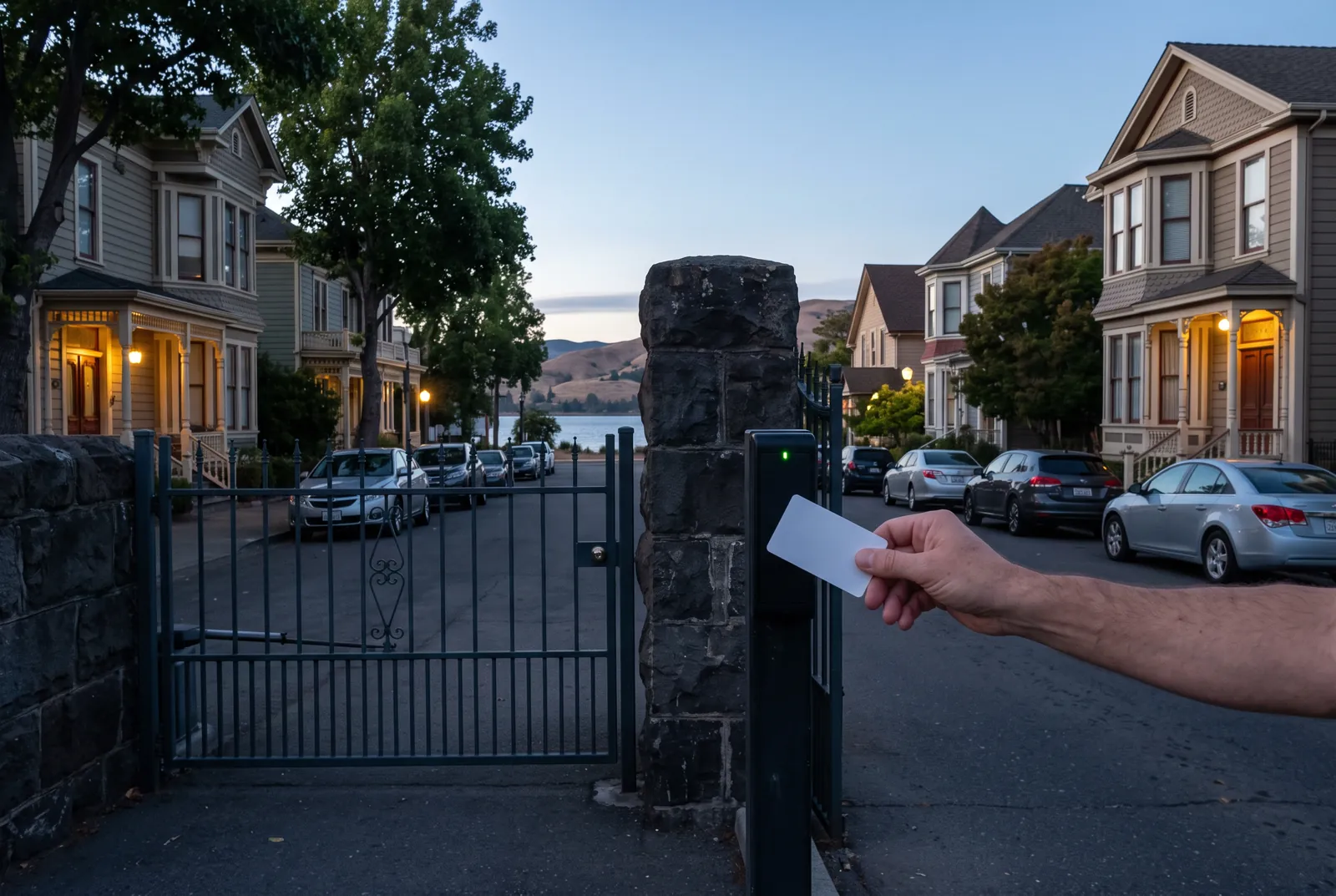
Hand somebody a key and you have lost control of it permanently. Hand somebody a credential and you can withdraw it on a Sunday night without leaving the sofa. That single asymmetry is what this whole page is built on, and the case for it is about administration rather than about anybody breaking in.
What gets fitted here is everything at the door itself, plus the box that runs it: pads and readers for cards or fobs, strikes and magnetic locks, sensors that release on the way out, the controller, and whatever credential your people end up carrying. It suits an office floor near the county buildings with staff and contract people moving through it, a records room where somebody wants a log, the stockroom behind a shop, a warehouse near the tracks whose crew turns over with the season, a gate at the yard end of the marina, and any landlord who has grown tired of paying to recut metal every time a unit changes hands.
During the survey three facts are recorded at every opening, and between them they choose the equipment, which is not the same as picking it out of a catalog. What the leaf is built from. What is already fitted in it. And the distance to the nearest power and network points. Timber or hollow metal in a deep frame will take a strike. A glass front whose upright is too slim for one takes a magnetic lock across the head, released by a sensor overhead and a button on the wall inside. An old leaf holding a bronze case takes the strike in the jamb, which is the neat answer in this town, because the frame does all the work and the case never leaves the door it was cut for. A yard gate runs off whatever operator is already there. Two positions in the controller are left empty against future doors, and the credential chosen is whichever one your staff will genuinely have on them, which more and more means a phone.
Every building keeps at least one opening on a mechanical cylinder with a restricted key. That is deliberate design, not a lack of faith in the electronics. Take every piece of metal out of a building and the first serious power failure shuts it, and the same reasoning applies to a house. The system runs the place day to day. Something mechanical still has to let people in when it cannot.
The same boundary applies here as everywhere else on the site. Anything at the door end belongs to this trade, which means the pads, readers, strikes, magnetic locks, exit sensors, controllers and credentials. Fire panels, intruder alarms and the motors on gates do not. Pricing is per project, set out opening by opening, with the equipment, the controller, the credentials and the hours all on lines of their own so that nothing disappears into a total. The $89 survey is deducted from the job. Approved quotes hold, and where an opening turns out to want preparation that could not be seen from the corridor, it is discussed and agreed as a line of its own while the work is happening rather than surfacing later on the bill.
“Two doors on readers and a keypad at the yard gate, all working, and the technician left a key override on every leaf which was the part I cared about. Marking it four because the first visit ran out of daylight and the second door waited until the following morning, though nothing extra went on the bill for the return. Credentials were issued in front of me and the old badges died the same afternoon.”
Sixteen jobs, fourteen of them with a range and two quoted once the openings have been counted on site. What moves a figure inside its range here is what is actually in the door: a cast mortise case that comes apart, cleans up and goes back in takes the low end, while a case seized with a century of paint, or one that has to be replaced because a part inside it is broken beyond repair, takes the high one. Say what the key does when you turn it, and the range closes to a single number on the call.
- Daytime (7am–8pm)standard rates
- Evening (8pm–12am)+$45
- Overnight (12am–7am)+$85
FAQ
Access Control: quick answers
Every turnover costs us a set of keys. Is this what stops that?+
For that particular problem it is. Withdrawing a credential takes less than a minute at a screen. A key that never comes home means every cylinder it opened has to be repinned, which is a morning's work and a bill. Where units turn over often, the sums come out in favor of readers on the openings that matter and ordinary keys everywhere else. Very few buildings justify a reader on every door.
Does an old door have to be replaced to take a reader?+
No, and usually it should not be. The strike goes into the frame rather than into the leaf, so the bronze case, the knob and the escutcheon stay exactly where they have always been and the corridor looks unchanged. What does need planning is the cable run, because frames in these buildings do not always offer an easy path, and that is worked out during the survey.
There is nothing but glass and a narrow frame at the front of our shop. What can be fitted?+
A magnetic lock across the head of the frame, since that upright is too slim to hold an electric strike. Inside, a sensor above the door and a button beside it release it on the way out. Nothing is taken out of the upright itself, so the deadlatch that is in there now carries on doing its job, and the shop still locks on a key once the maglock has been dropped for the night.
Related
More commercial services
Open 24 hours, 7 days
Say whether the key meets a keyhole or a cylinder, and the rest of the call is quick
Martinez and the towns around the strait, around the clock. What sits in the edge of the leaf decides the work and the work decides the number, which is settled on the phone with the $89 visit and any late hour already inside it. It reads the same on the receipt. Ninety days on the labor, a rebuilt bronze case covered the same as a new lock.