Master Key Systems in Martinez
Quoted once every opening has been walked and listed. A floor of offices near the courthouse, or a row of Main Street units, arranged so one key covers what an owner needs and no tenant key covers anything beyond its own door.
4.9 / 5· 143 reviews from Martinez and central Contra Costa
custom quote
Typical price
18 min
Avg. arrival
24/7
Availability
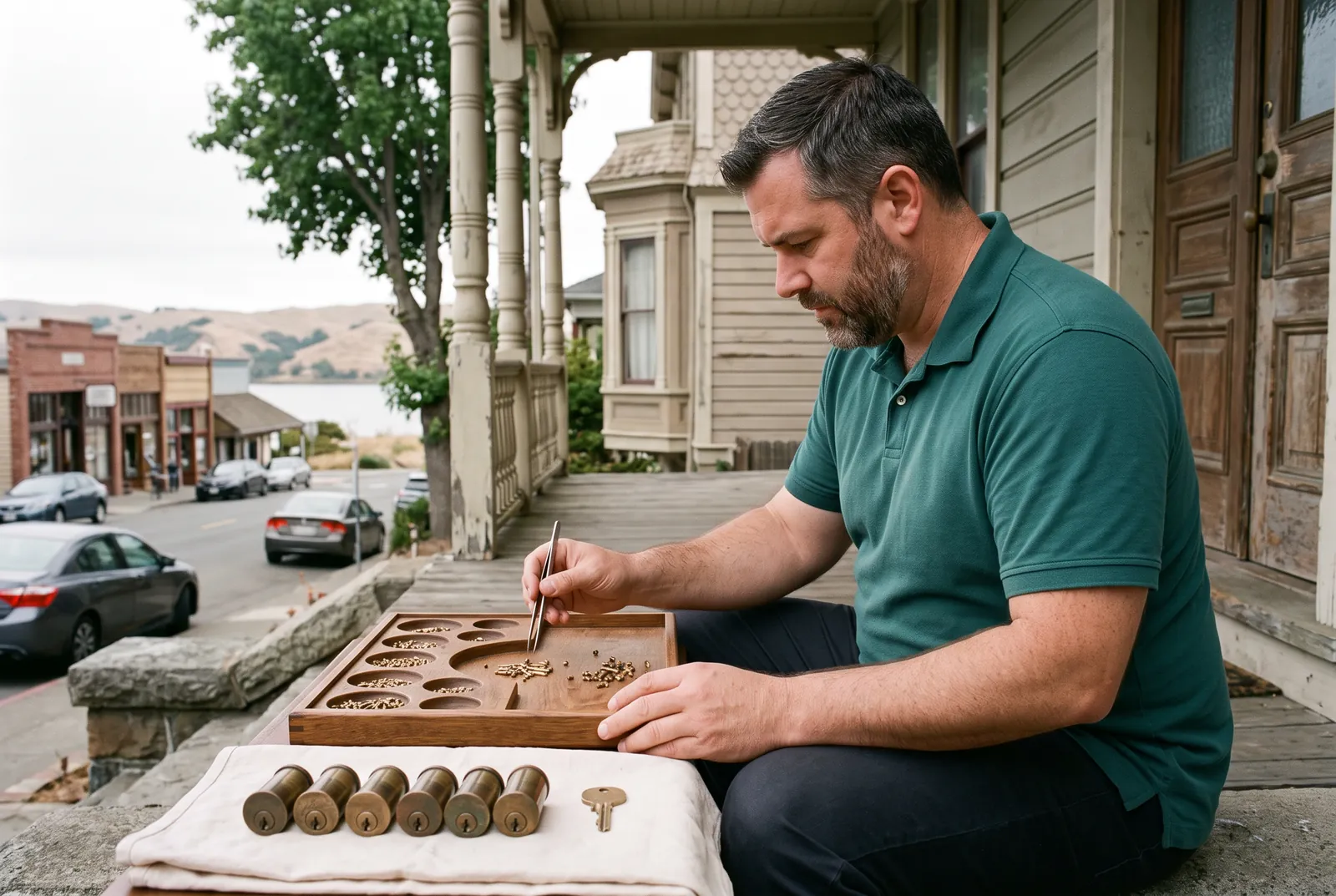
A master key system is an order of precedence held in metal. A tenant, a department or a crew opens their own door and stops there. A master takes a floor, a row of suites or the whole property. Above that, sometimes, sits a grand master for an owner or a manager. Drawn well, it turns a drawer full of keys into one key worth looking after. Drawn badly, it hands somebody a key to a door nobody meant them to have, which is worse than running no system.
That is why no figure goes out over the phone. The building gets walked first, opening by opening, and four things are established at each one: the hardware hanging in it, whether that hardware can hold the pinning a hierarchy demands, who genuinely has to get through it, and whether it should be part of the scheme at all. Some doors should not be. Owners routinely underestimate how many. Server rooms, a cabinet where records live, a store with controlled stock in it, and in a law suite it is very often a single file room the rest of the floor has no business entering.
Martinez adds a complication of its own and it tends to decide these jobs. The buildings around the courthouse are old, and a fair share of the corridor doors carry bronze mortise cases on bit keys, which cannot hold a hierarchy at all. Those cases do not go in a skip. Each is bored for a mortise cylinder on a restricted keyway and returned to the pocket it has always occupied, so the door keeps the hardware it was built with and gains a key that means something. The shapes that repeat here are a law or title suite over a Main Street storefront, an office floor near the county buildings with a server room in it, a shop with a stockroom and an alley door, a row of boat sheds at the marina running padlocks that ought to share one key, and a warehouse near the tracks with a gate, a man-door and a mezzanine office.
Nearly all of the skill in this job goes into the paper. Fitting it takes an afternoon. Once the walk is done the levels are laid out and agreed, a profile that cannot be duplicated at a counter is chosen to sit beneath them, and then each cylinder goes to the bench to be built with the master stack sitting over the change stack. Every one of them is carried back to the door it came from and turned there with each key that ought to open it. Cylinders already in the building that are in decent shape are brought into the scheme instead of scrapped, and that is where most of the money is saved. Bows carry a stamped level, numbers go into a log, and what you are left holding maps each opening against each key entitled to it, with room on the sheet for openings that do not exist yet.
One figure arrives after the walk, itemized. No published range could be honest here, because the total swings on how many doors there are, how many levels of key, which profile you settle on and what condition the hardware is in. The $89 call-out pays for the survey and then comes off the job. Approve the quote and the quote is what you pay. Down the line, when one tenant hands back a key, that single door is repinned for $27 to $44 and nothing else in the building is touched.
“Eleven doors on the second floor above Main Street, three tenants, and a master key that had been out in the world since before I took the building over. The locksmith walked every opening with me and wrote them down before quoting anything, which is the opposite of the phone estimate I got elsewhere. Each tenant now opens their own suite and nothing else, and my key opens the lot. Took one long Saturday and we haven't had a key question since.”
Sixteen jobs, fourteen of them with a range and two quoted once the openings have been counted on site. What moves a figure inside its range here is what is actually in the door: a cast mortise case that comes apart, cleans up and goes back in takes the low end, while a case seized with a century of paint, or one that has to be replaced because a part inside it is broken beyond repair, takes the high one. Say what the key does when you turn it, and the range closes to a single number on the call.
- Daytime (7am–8pm)standard rates
- Evening (8pm–12am)+$45
- Overnight (12am–7am)+$85
FAQ
Master Key Systems: quick answers
Every other page here has a number on it. Why does this one not?+
Because the total turns on how many doors there are, how deep the hierarchy has to run and what state the hardware is in, and none of that survives being described down a phone line. A figure produced without anyone setting foot in the building is a guess, and guesses get corrected halfway through the installation, when half the cylinders are already sitting on a bench.
Our suite is upstairs off Main Street and the doors take old bit keys. Is a system even possible?+
It is, and the old cases stay in the building. Each one is bored for a mortise cylinder on a restricted keyway and goes back into the pocket it has always sat in, so the corridor looks exactly as it did while the hierarchy runs underneath it. That costs less than replacing the hardware on those doors and it keeps the building looking like itself.
A manager left and the master never came back with them.+
Go to the chart before anything else, since it sets out exactly which openings that key reached, and those are the only cylinders needing work. Everything sitting below it in the hierarchy carries on as before, which keeps both the bill and the number of people who have to be told about it down. Because the profile is restricted, nowhere could have produced a duplicate, so the problem is one missing key and not a quantity nobody can establish. The figure comes off the door count on the chart and is stated before anyone starts.
Related
More commercial services
Open 24 hours, 7 days
Say whether the key meets a keyhole or a cylinder, and the rest of the call is quick
Martinez and the towns around the strait, around the clock. What sits in the edge of the leaf decides the work and the work decides the number, which is settled on the phone with the $89 visit and any late hour already inside it. It reads the same on the receipt. Ninety days on the labor, a rebuilt bronze case covered the same as a new lock.