Storefront Door Locks in Martinez
$152 to $449. Aluminum and glass doors downtown, where the faults repeat: a hookbolt stopping short of the keeper, a deadlatch worn too shallow to hold, a cylinder binding by mid-afternoon, a closer that has been pulling the frame out of true for a year.
4.9 / 5· 143 reviews from Martinez and central Contra Costa
$152–$449
Typical price
18 min
Avg. arrival
24/7
Availability
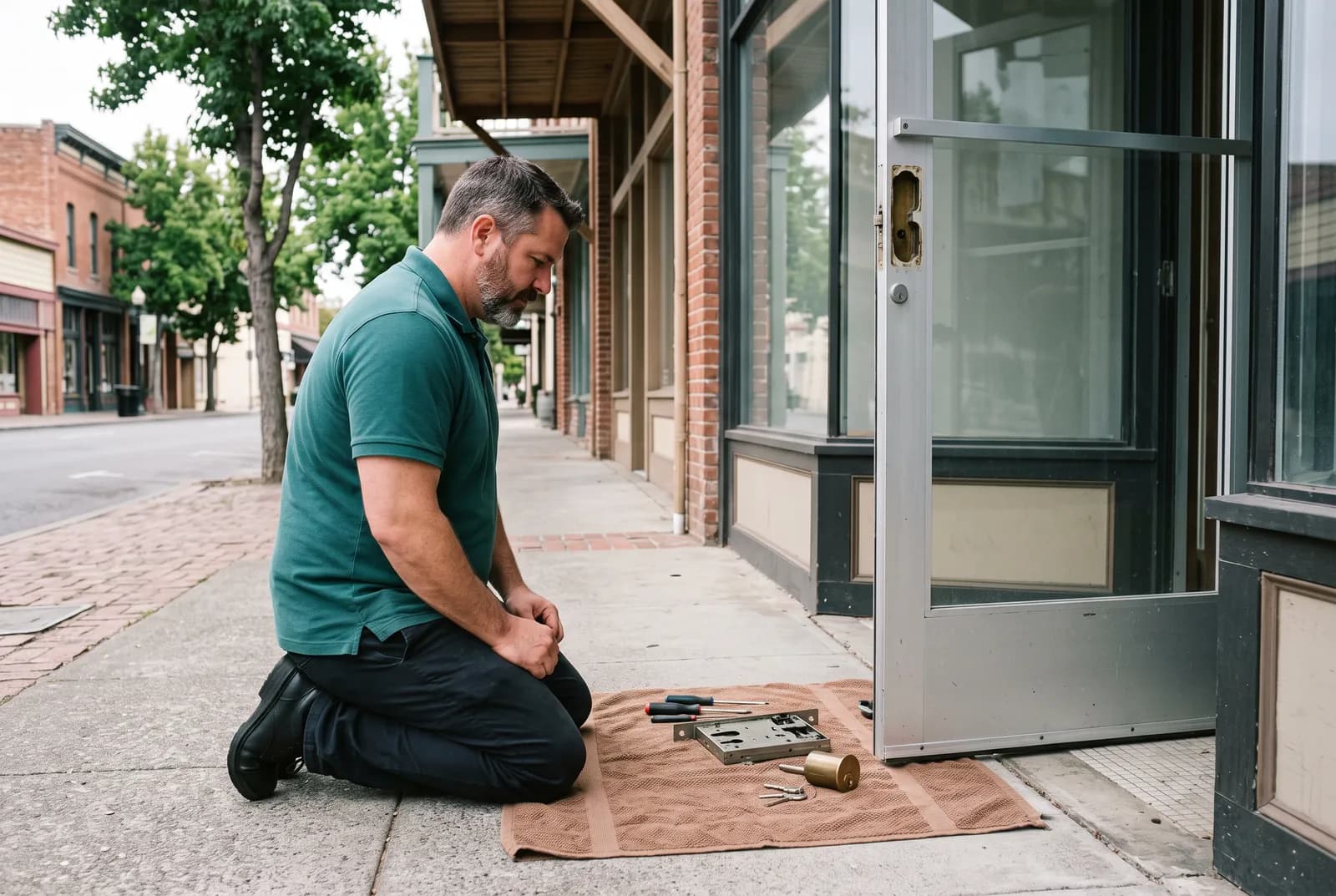
Two quite different doors repeat along Main Street, Ferry Street and the blocks around them. One is a sheet of glass in a slim aluminum frame, its lock buried inside an upright barely two inches across, and nothing in a hardware store will fit it. The other is the original wooden storefront leaf: tall, heavy, a bronze mortise case in the edge and a century of paint down the stiles. Go upstairs to the offices and it is the second kind almost without exception.
At the aluminum door the first thing done is to swing it shut and watch the latch arrive. The lock is usually blameless and the leaf has sagged. Doors of this kind ride on a pivot top and bottom, the lower one wears, and after some years the deadlatch is landing three or four millimeters short of its pocket. Fitting a pivot and shifting the strike to suit costs a small share of a lock and settles the great majority of these calls. The wooden leaf has its own version of the same complaint, and it is paint: layers on the stop and inside the strike pocket rob the bolt of the last of its throw, while all that finish has added enough weight that the leaf now hangs low on hinges that were adequate when it was bare timber.
Where the deadlatch itself has genuinely shortened with wear, it is exchanged for a new one. A hookbolt is the right answer on a pair meeting at a center mullion, or on any door somebody has already gone at with a bar, because it rotates in behind its keeper and no amount of spreading will pull it out. The cylinder in the upright is either repinned or replaced with one whose cam and tailpiece actually suit the lock body in front of it, which is precisely where parts bought over a counter come unstuck. On the wooden leaves the case is drawn out, cleaned and returned, and if the shop needs that door to resist somebody rather than merely latch, the case takes a modern cylinder. Add a thumbturn on the inside face and closing up stops involving a key and the sidewalk at eleven at night.
Swap a deadlatch or fit a fresh mortise cylinder and the figure is $165. Per opening, hardware included, the range runs $152 to $449 with the $89 call-out inside it, and the far end is a hookbolt deadlock on a restricted cylinder together with a paddle handle and a closer reset on a heavy leaf. Where somebody has left the payroll holding a key, repinning the cylinder in the upright is $27 to $44. Work between 8pm and midnight already carries its $45, so that $165 job is quoted at $210. Nothing is averaged: a shop with a front and a back door is given a figure for each of them. Ninety days on the labor.
“Our aluminum shop door stopped locking by about three every afternoon once the sun got on the frame. The tech found the hookbolt was stopping a hair short of the keeper and the closer had been pulling the whole thing out of square for a year. $310 for a new deadlatch, the cylinder swapped and the closer set properly. It's locked first try every night since, which after fourteen months of shoving it is a small miracle!”
Sixteen jobs, fourteen of them with a range and two quoted once the openings have been counted on site. What moves a figure inside its range here is what is actually in the door: a cast mortise case that comes apart, cleans up and goes back in takes the low end, while a case seized with a century of paint, or one that has to be replaced because a part inside it is broken beyond repair, takes the high one. Say what the key does when you turn it, and the range closes to a single number on the call.
- Daytime (7am–8pm)standard rates
- Evening (8pm–12am)+$45
- Overnight (12am–7am)+$85
FAQ
Storefront Door Locks: quick answers
The key turns at close and the door still comes open when somebody pulls it.+
Get inside, ease the door closed and keep your eye on the latch as it comes in. If it is finishing its travel below the pocket, the lower pivot is worn and the whole leaf has settled, which a fresh pivot and a repositioned strike will put right. If it reaches the pocket and then jumps straight back out under load, the deadlatch has lost length and is exchanged. Neither takes long, and both are booked into the hour before you unlock.
The old wooden door on our shop will not lock unless somebody leans on it.+
Paint on the stop and in the strike pocket, near enough every time. The bolt is running out of travel before it is properly home, so it only holds while the leaf is being pushed. The joint is scraped back, the pocket cleared and the strike reset, and the case comes out for a clean while everything is apart. That is finish work rather than hardware, and it is priced that way.
An employee we let go never returned their key.+
That is a quarter of an hour of work. The cylinder is drawn out of the upright, taken to the bench for a new pin stack at $27 to $44, and put back where it came from, at which point the key in that person's pocket is a piece of brass. Whoever is still trusted to lock up gets a freshly cut key. The deadlatch, the closer and the glass are not touched at all.
Related
More commercial services
Open 24 hours, 7 days
Say whether the key meets a keyhole or a cylinder, and the rest of the call is quick
Martinez and the towns around the strait, around the clock. What sits in the edge of the leaf decides the work and the work decides the number, which is settled on the phone with the $89 visit and any late hour already inside it. It reads the same on the receipt. Ninety days on the labor, a rebuilt bronze case covered the same as a new lock.