The list is longer than the sale
Think about how many people were inside the house in the six weeks before you owned it. Both agents. Whoever staged it and whoever moved the staging back out. The photographer. The inspector, and then the second inspector who went under the floor with a flashlight. The roofer who came to price a section. The gardener who kept it looking sold. And everybody who walked through on a Sunday while somebody sat at a table by the door. The lock box came off at the end, and the number of keys that had been cut in the meantime was nobody's job to know.
Behind that there is a longer history. Downtown and the flatter streets near the station carry a lot of rented housing, so the place may well have been let at some point, and a tenancy issues keys every time it turns over. A front door of this age has also had at least one owner who lost a key on a hillside somewhere and had another one made.
None of that is an accusation and none of it is unusual. It is simply a list that nobody ever closed. The first month is when you close it, and closing it is not a question of trust. It is a question of how many keys should exist from here on and what each one opens.
Why one key for everything is the wrong target here
On a house built to one plan in one year, everything takes the same blank and a single key is a sensible goal. That is not the housing stock in this city. A house on the slope above downtown may have an original mortise case on the front with a keyhole for a bit key, a cylinder somebody added into the back door in the seventies, a padlock on a gate, a detached garage with hardware from a hardware counter and a basement door under the porch with something older than all of it.
A key can only be made for a cylinder it physically enters, so anything sharing a key has to share a keyway family. Several of these locks can be brought into one family as they stand, and one or two more will come in once a matching cylinder goes into the existing case, which is a part and twenty minutes. Others will not join at any price worth paying, and hearing that is more use to you than being sold four new locks so the outcome looks tidy on paper.
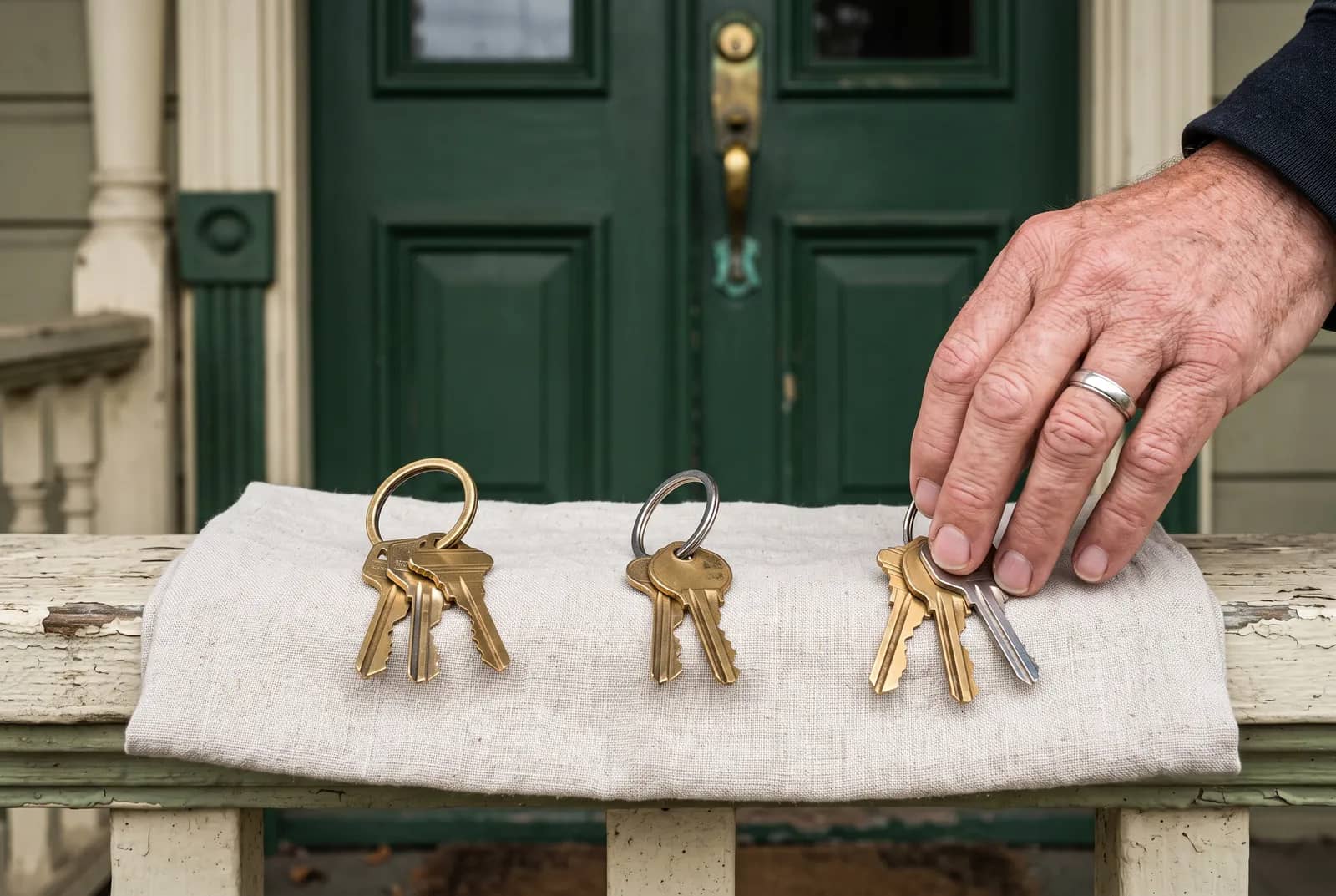
So the useful target is not one key. It is a small number of keys, each of which you can describe in one sentence. Three is the number most households here land on.
Ring one: the doors the household uses
The front door, the back door and the gate you actually walk through. This is the key that goes on everyone's ring, gets carried to work and gets left with the neighbor who waters things. It should open every door you use daily and nothing that you would not want opened by whoever finds a lost ring on the sidewalk.
This ring is the first job and it is the least expensive useful thing you will do all month. Rekeying is $27 to $44 per cylinder. The first one carries the setup, since a combination has to be picked and a key cut and proved to it, and each one after that repeats a pattern that already exists, so it lands low in the band. The $89 visit is charged for the stop, not for each lock on the list. At the end of it, whatever brass is circulating from before you owned the place opens nothing.
Ask for one more copy than you think the household needs, and try each of them from the porch with the door shut. A key that works while the lock is in somebody's hand has not been tried. Then write on paper which copy went to whom. That note is thirty seconds now and it is the difference between a decision and a guess the next time somebody asks whether the locks need doing again.
Ring two: the key that can be handed to somebody else
There will be a painter, a plumber, somebody delivering a washing machine and a cleaner. Handing them ring one means the whole house is open to a key you cannot get back, and it means a rekey every time an arrangement ends. The alternative is one door, deliberately chosen, on its own key.
On most houses here the honest candidate is the back door or the basement door under the porch, because it reaches the parts of the house a trade needs and does not open the front. On a property with a detached garage or a workshop at the end of the drive, that building is often the better answer: the key opens the space where the work is and nothing else.
Whatever the door, it stays a separate cylinder on purpose, and it is the one you change when a job ends. That is one cylinder at $27 to $44 rather than a visit to every door on the property, which is the entire point of arranging it this way at the start rather than after the fact.
Ring three: the keys that never leave the house
Old houses come with keys that are not door keys in any practical sense. A bit key for an interior mortise lock on a bedroom or a pair of pocket doors. A small flat key for a wall safe left behind by somebody. A key for a hatch, a meter cupboard or a crawl space. These are worth keeping and worth labeling, and they belong in a drawer rather than on anybody's ring.
Two things about them. First, do not have the interior mortise locks rekeyed or replaced in a burst of enthusiasm. They are part of the house, they hold nothing that matters, and they are the sort of hardware that cannot be bought again. Clean and re-spring them if they are stiff and leave the rest alone.
Second, label them at the moment you first work out what they open, because that moment does not come round again. A tin of unlabeled old keys is the single most common thing handed over at a closing in this city, and the single least useful.
What cannot join any ring, and the week to do this in
The mailbox, if your mail arrives in a shared box, belongs to the postal service and is dealt with by them rather than by a locksmith or by you. A sealed padlock from a bin has nothing inside it to repin, so it is matched and replaced rather than brought onto a key. Keypad codes are changed rather than rekeyed, and they should all be changed in the first week because it costs nothing. And a garage remote is not a key at all: clearing what a door opener remembers is done at the opener itself, by the procedure in its own manual, and no work on any cylinder touches it.
On timing, aim at the week you close rather than the week the truck comes. A house with nothing in it is the quickest work anybody gets: every door swings clear, no furniture is standing against anything, and the list finishes in one stop. It is also the week that deals with the keys that were most widely held, because those were in circulation while the rooms were empty and anyone could be shown around.
The total for the month is modest. Rekeying at $27 to $44 a cylinder with the $89 visit counted once for the stop. A deadbolt at $119 to $315 anywhere an outside door is running on a latch and nothing else. And an overhaul of the original front lock if it has gone stiff, which on these houses is a far more frequent finding than a lock that has genuinely failed. Evening arrivals carry $45 and overnight ones $85, both named on the call. Ninety days on the work.
Quick answers
Do we need new locks after buying, or is a rekey enough?+
New pins in the cylinders you already own answer the only question a sale raises, which is who can still get in, and that runs $27 to $44 a cylinder. Buying hardware at $119 to $315 a door to achieve the same thing is paying for metal you did not need. On a house of this age the original front lock is usually worth overhauling and keeping.
Can everything on an old house go on one key?+
Frequently not, and that is not a defeat. A key enters only the cylinders whose keyway it matches, and a house here can be carrying hardware from four different decades at once. Some doors join a set once a matching cylinder goes in, which is a part swap. Where one will not join, two or three deliberate keys beat six accidental ones.
What should a cleaner or a contractor be given?+
One door on its own cylinder, chosen so it reaches what they need and not the front of the house. When the arrangement ends, that single cylinder is rekeyed at $27 to $44 instead of every lock on the property. Deciding it at the start is what makes it cheap later.
Need it handled rather than read about?
(925) 436-1856More guides