The lock lives in the edge of the door, not in a hole through it
Walk up the porch steps of one of the two-story wooden houses on the slope above downtown, open the front door and look at the edge of the leaf rather than at the knob. There is a brass or bronze plate running several inches up and down the stile, with the latch and the bolt coming out through it and two small screws holding it in place. That plate is the face of a lock case buried inside the wood, and the case is the whole machine.
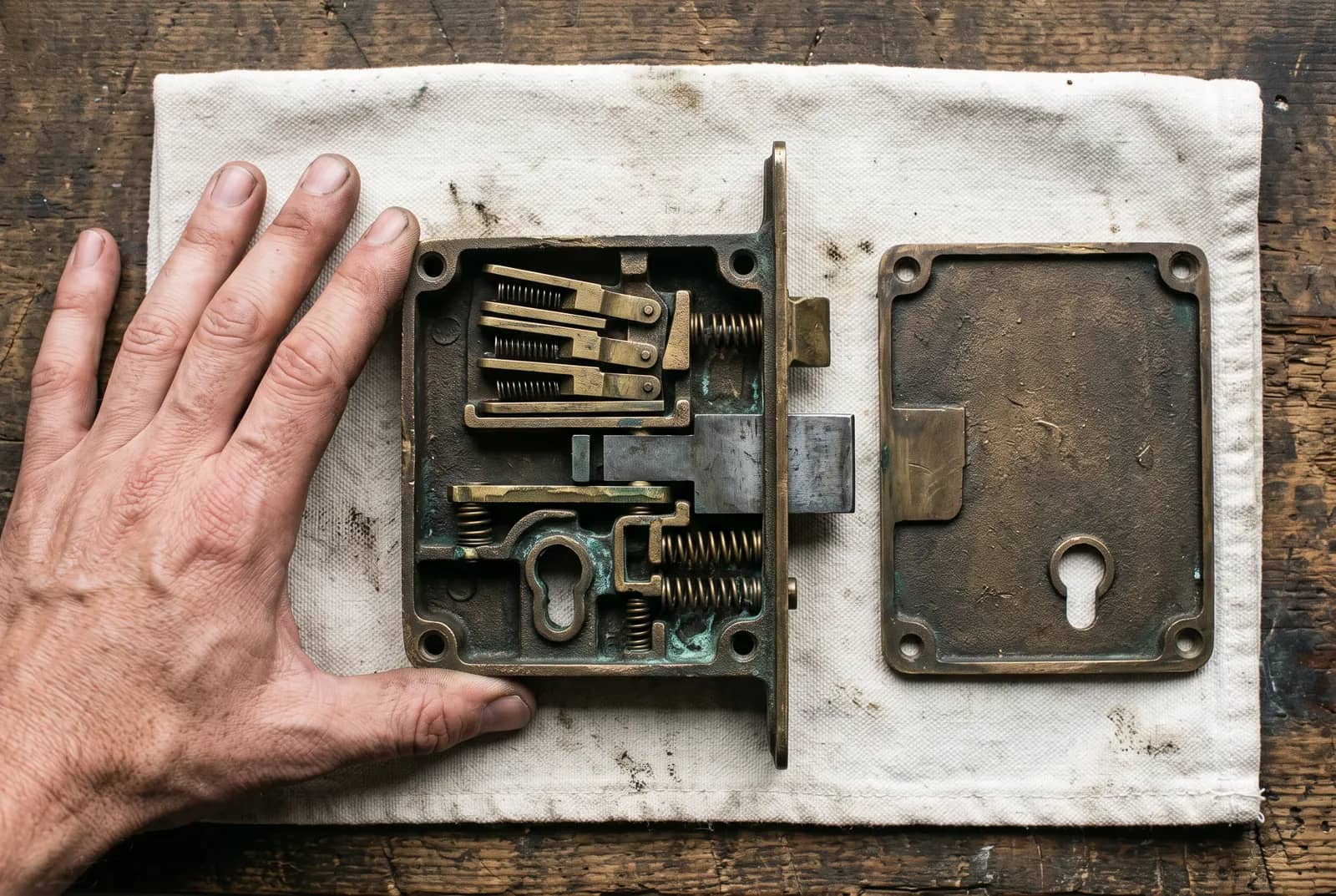
This is a mortise lock, and it is the oldest arrangement still in daily service anywhere on these streets. A carpenter chiselled a rectangular pocket into the edge of the stile, the case dropped into the pocket, and the knob spindle, the keyhole and the two screws came through from the faces of the door afterward. Nothing about it is a hole saw and a template.
Almost everyone who calls about one describes it as a lock that has finally worn out after a century. It generally has not. What has usually happened is that one part inside a case the size of a paperback has stopped doing its job, and that part is a spring, a pin or a screw rather than the lock.
What is actually in the case
Take the cover plate off on a bench and you are looking at maybe a dozen pieces, all of them visible at once. A latch with a bevel on it, held out by a coil spring. A square bolt that only moves when the key moves it. A hub in the middle, which is the square hole the knob spindle passes through, with arms on it that pull the latch back when the knob turns. And a stack of flat steel levers or a set of fixed wards, depending on how the case was made, which is the part the key actually works against.
Everything is riveted or screwed to a cast back plate. There are no clips, no plastic carriers and no parts pressed together in a way that cannot be undone. That was not foresight about the future. It was simply how hardware was made when the alternative to repairing something was buying it again from a catalog and waiting on a train.
The bronze itself is the reason these survive. A cast case is thick, it does not corrode away in a hallway, and it carries the load of a heavy leaf on its spindle without deforming. What sits inside the case is steel, and steel is the part that gets tired first. That split, a body that lasts and internals that wear, is the entire argument for opening one up.
The three faults, in the order they turn up
First, hardened grease. Whatever was put in the case when it was made became a varnish decades ago, and it holds the levers and the latch tail against the plate they are meant to slide across. This is the commonest single complaint in this city: the key goes in, turns partway and stops, or turns all the way and the bolt only creeps out. Nothing is broken. The inside is gummed solid and, on top of that, has a century of house dust stuck to it.
Second, a spring. Coil springs behind the latch and flat springs under the levers are the finest steel in the assembly and they are compressed every time somebody comes in. When the latch spring goes soft the latch stops snapping back out and starts easing out, so the door stands closed against the frame rather than latched into it. People notice that as a door the wind can push open, and they blame the wind.
Third, the hub and the spindle. The spindle is a square steel bar with a set screw pinching each knob onto it. Decades of daily turning wear a flat onto the bar and round off the corners of the hub, so the knob travels further and further before the latch follows, until one day it turns freely and the door stays shut. That one is a part rather than a repair, and the parts are still made.
What a rebuild actually is
Two screws in the face plate and the case slides out of the pocket in one piece. The cover comes off, the parts come out in order, and everything is washed rather than sprayed with something while it sits in the door. Old grease off, dust out, the sliding faces cleaned back to bare metal, a spring replaced where a spring has gone soft, the spindle swapped if it has a flat worn into it, and a dry lubricant that will not collect dust for the next thirty years.
Then it goes back into the same pocket, in the same door, and the household gets its own lock back with the action it had when the house was new. It is not a sentimental exercise. A case of this kind, cleaned and re-sprung, will outrun the replacement it would have been swapped for, because the replacement would be a stamped case where this one is a cast one.
The alternative is worse than it looks. Fitting a modern bored lock to one of these doors means the mortise pocket has to be filled with a glued-in block and a round hole cut through the face of the stile where the pocket used to be. That is a lot of wood removed from a narrow strip beside a hundred-year-old panel, and it cannot be put back. Where the mortise case can go back in, it goes back in.
Where the old case is not the whole answer
It is worth saying plainly, because plenty of websites will not. An old mortise lock is repairable, which is a real virtue. It is not, on its own, resistance. A case with a warded keyhole and a short bolt was made when the expectation of a front door was different, and a rebuilt one is a working lock rather than a hardened one.
So on a house where somebody actually wants resistance, the sensible arrangement is both. The original case is rebuilt and stays in the door, doing the latch and the everyday turning, and a modern cylinder goes into the picture in one of two ways. Some cases were made to take a threaded cylinder in the face of the door and can simply be given a current one. Where the case has only a keyhole, the answer is a separate deadbolt fitted above the knob, at $119 to $315, cut into solid stile with the bolt landing in a pocket in the frame rather than in a strip of casing.
Which of those suits a particular door is decided at the door with the case in hand, not from a description on the phone. What is decided on the phone is that nothing gets thrown away before somebody has looked inside it.
The figures, and what is honestly not fixable
Taking a case out, overhauling it and refitting it is priced as lock replacement and installation, $119 to $315, and a job where nothing is bought and the work is a clean, a spring and a spindle sits near the bottom of that. The $89 visit is inside whatever figure you are told, rather than waiting for you at the end. A van arriving between 8pm and midnight carries $45 and between midnight and 7am carries $85, and both are named on the call. The work carries ninety days, and any part that goes in carries whatever its maker gives it, with both lines printed rather than described.
If the case takes a cylinder and the question is only who holds a working key, that is rekeying at $27 to $44 per cylinder and the case stays exactly where it is. If the door has already closed on you, a house lockout is $125 to $229, and a lock of this kind is very often opened through the keyway with nothing marked. On a leaf where the stile beside the pocket is the only wood there is, that is not a small distinction.
Two endings are genuinely terminal, and they get said out loud. A cast case that has cracked across the spindle hub, which happens when somebody hangs their weight on a knob, cannot be welded back into a lock anybody should rely on. And a stile that has split along the pocket, usually after the door was forced at some point in its life, is joinery before it is lock work. In both cases the honest answer is what has to happen next, not a better lock screwed to a door that cannot hold one.
Quick answers
Is a hundred-year-old lock worth keeping in the door?+
Usually, and it is the ordinary outcome here. The case is cast bronze and does not wear out. What wears out is a spring, a spindle or the grease, and all three are dealt with on a bench with the case out of the door. What an old case does not give you on its own is modern resistance, which is why a deadbolt often goes on above it.
The knob turns and the door does not open. Is the lock finished?+
Rarely. The square spindle has worn a flat where the set screw grips it, or the arms on the hub inside the case have rounded off, so the knob turns without pulling the latch. A spindle is a stock part and a hub is a case swap. Neither is a reason to cut a new hole in the door.
Can I just put a normal deadbolt on the door instead?+
A deadbolt above the knob is a fair addition and it is $119 to $315 fitted. Replacing the mortise lock with a bored set is a different proposition, because the pocket has to be filled and a two-and-an-eighth-inch hole cut through the stile where the pocket was. On a narrow stile that is a lot of wood gone and it does not come back.
Need it handled rather than read about?
(925) 436-1856