Three kinds of keyhole on the same street
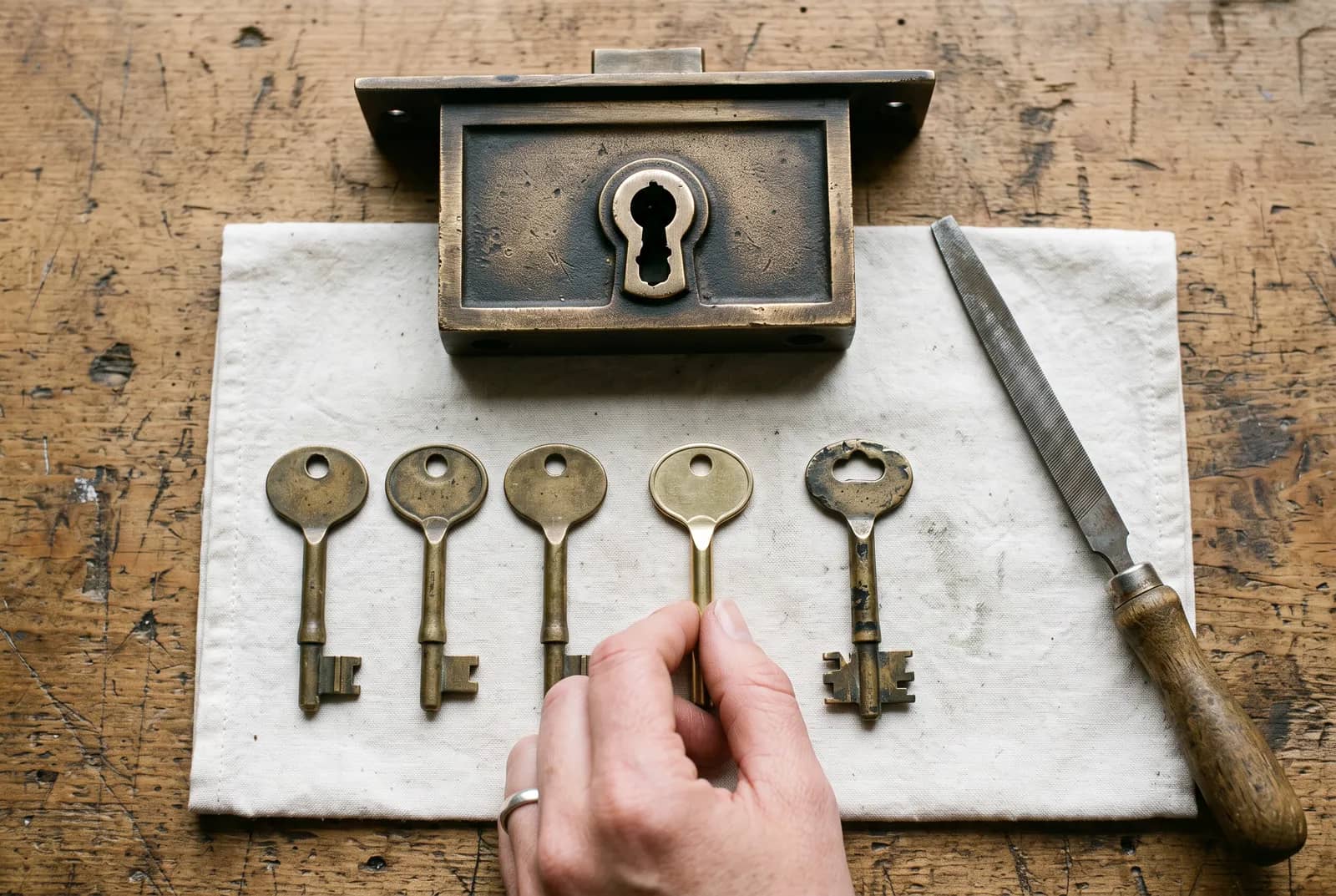
Before anything else, look at the hole. A tall keyhole shaped roughly like an upside-down bottle, wide at the bottom, takes a bit key: a shaft with a flat rectangular wing on the end. A small round hole with a slot cut across it, usually in a brass ring, takes a modern-style key with cuts along its top edge and pins behind it. And on a fair number of doors here you will find both, because a cylinder was added into a mortise case at some point in the last hundred years while the original keyhole stayed where it was.
Those three are three different jobs with three different answers, and the whole conversation is shorter once you know which one you are looking at. A photograph of the keyhole taken with the phone light on, and a second one of the plate on the edge of the door with any name or number stamped on it, gets most of this settled before anyone drives over.
The one thing that is true across all three is that a store counter cannot help. A blank for a hundred-year-old profile is not hanging on that rack, and the machine there is a copier: it needs an original to trace. With no original, there is nothing to trace, which is why people are told at the counter that the lock has to be replaced. That is the counter's honest limit rather than an answer about your door.
The bit key, and what a new one is made from
Blank bit keys are still made, in a range of shaft diameters and wing sizes, and a van that works these streets carries a selection of them. Making one work is a matter of finding out what is inside the case and cutting the wing to clear it.
There are two routes. The clean one is to take the case out of the door, lift the cover and read the mechanism directly. Fixed wards are cast obstructions the wing has to pass through, so the notches are marked out from the wards themselves. A lever pack is a stack of flat steel levers, each needing to be lifted a particular height, and the heights are read off the levers with the case open. Then the blank is filed, tried, filed again, and the key that comes out is a key made for that lock rather than a copy of anything.
The other route is impressioning, used when the case is not coming out easily or the door has to stay shut. A blank is smoked or coated, put in, turned gently against the mechanism, and the marks left on the wing show where metal has to come off. It is done in stages and it takes patience rather than force. It is also the reason nobody should be filing away at a bit key blank in a vise at home: the first heavy cut in the wrong place ruins the blank, and a blank filed too deep will lift a lever past its gate and lock the mechanism harder than it was.
The old cylinder in a mortise case
Where a cylinder has been fitted into the case, the key has pins behind it, and pins can be measured. The cylinder unscrews from the face of the door, the plug comes out on a follower, and the depths of the pin stacks are read one at a time. A key cut to those depths works first time, without anybody guessing.
That is the ordinary outcome and it is quick. The complications are two. The keyway may be an old profile that needs a blank nobody stocks at a counter, which the van either carries or does not, and that is answered on the phone rather than in your hallway. Or the plug is worn enough that a key cut to correct depths is loose in it, which is not a failure of the key. It is a cylinder that has done its distance.
If the cylinder came off a family that is still made, this is also the natural moment to bring it onto the same key as the rest of the house, at $27 to $44 per cylinder, since the plug is already out and on the bench. Doing it later is a second visit for the same fifteen minutes of work.
Making a key is not the same as retiring the old one
This is the part people are surprised by, and it decides more of these jobs than the cutting does. If your key is lost rather than worn out, then somewhere there is a key that still opens your front door, and a new key made to the same lock does not change that. Both work. Nothing has been retired.
Where the lock has a cylinder, that is easily settled: it gets repinned, the new key works, and every key ever cut before today stops. Where the lock is a warded or lever case with a bit key, there is no repinning to be had in the modern sense. A lever pack can sometimes be reordered so the old key no longer lifts it, and where that is possible it is the neat answer. Where it is not, the honest choices are a cylinder fitted into the case if the case will take one, or a separate deadbolt above the knob at $119 to $315 that becomes the lock the household actually relies on, with the original left doing the latch.
So say on the call which of these you are dealing with. A key that snapped, or that went missing off a ring in your own hallway, is a different problem from a key that left the property with somebody. The bench work is identical. What happens after it is not.
When the cylinder or the case changes instead
There are four points where making a key stops being the sensible route, and they get named at the door rather than discovered on the invoice. A plug so worn that a correctly cut key rattles in it. A lever pack with a broken or missing lever, which makes the mechanism unreadable and unpredictable. A keyway corroded past the point where a fresh blank will run cleanly. And a case that has been drilled by somebody in a hurry before you owned the house, which is more common than you would think on doors that have changed hands often.
In those cases the case is usually still fine and only the cylinder changes, which stays inside the same $119 to $315 line and keeps the original hardware on the door. Replacing the whole case is the last option rather than the first, for the same reason as everywhere else on this site: the pocket in the stile was cut for the case that is in it.
The figures and what to have ready when you call
Making a key to an existing lock, whether that is a bit key filed to a lever pack or a key cut to a decoded cylinder, sits in lock replacement and installation at $119 to $315, near the bottom when the case comes out easily and toward the top when a cylinder has to be changed with it. Rekeying an existing cylinder, once a key exists for it, is $27 to $44 each. If you are shut out of the house right now, that is a house lockout at $125 to $229, and one of these locks is generally opened through the keyway rather than drilled.
The $89 visit is already inside whatever number you are quoted. An arrival between 8pm and midnight carries $45 and between midnight and 7am $85, both said on the call rather than at the door. Ninety days on the work.
Have three things to hand and the call takes two minutes. A photo of the keyhole. A photo of the plate on the edge of the door with any stamping on it. And an answer to whether any other door in the house takes the same key, because if one does, the fastest route to a working key is sometimes the lock next to the one you are worried about.
Quick answers
The hardware store says they cannot help. Is my lock finished?+
No. A counter machine copies an existing key, so with nothing to copy it has nothing to do, and blanks for old profiles are not on that rack. A key for one of these is made from the lock itself, either by reading the mechanism with the case open or by impressioning a blank in the keyhole.
Someone left with a key. Does a new key stop the old one working?+
Only where there is a cylinder to repin, which is $27 to $44 and retires every key cut before today. On a warded or lever case with a bit key there is often nothing to repin, so the answer is a cylinder in the case where it takes one, or a deadbolt above the knob at $119 to $315 that becomes the lock you rely on.
Can I file a blank bit key myself?+
It is how these keys are made, but the first heavy cut in the wrong place ruins the blank and a wing filed too deep will jam a lever pack harder than it was. If the case is out of the door and you can see the wards, it is a fair afternoon. Working blind through the keyhole is where people do damage.
Need it handled rather than read about?
(925) 436-1856More guides