A century of Saturday afternoons
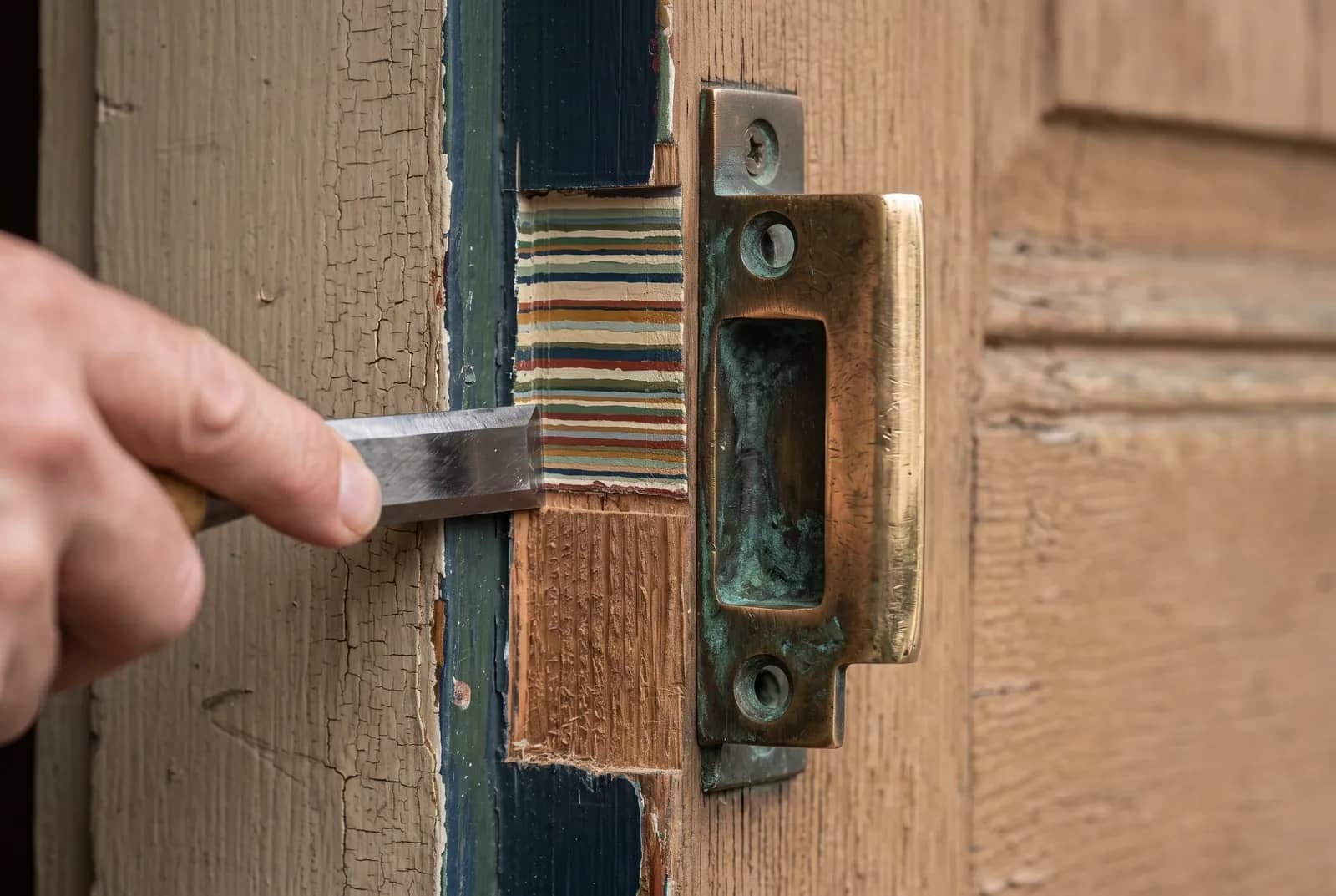
Look at the edge of a front door on one of the older streets where somebody has taken a lock off recently. Under the face plate there is a cut through the finish that shows the whole history of the house in cross-section: cream over gray over a green that nobody alive chose, over the varnish that was on it first. Nobody ever stripped it. Each owner painted over what was there, because that is what people do with a door that is still working.
Each of those coats is a couple of thousandths of an inch. Twenty of them, on the edge of the leaf and on the face of the frame it closes against, is a measurable amount of material in a place with almost no clearance to spare. A bolt pocket in a jamb is cut close around the bolt on purpose, and paint fills it from every side.
So a share of the calls in this city are not lock faults at all. They are paint faults, and the tell is in the timing. A door that locked every night for years and stopped in the month after the house was painted has not developed a mechanical problem. It has been given a thicker frame to close against.
The four places it collects, and what each one does
The stop, which is the strip of the frame the door shuts against. Paint here holds the leaf a fraction further out than it used to sit, and the bolt now falls short of the pocket it has been reaching into since the house was built. This is the single commonest version. The key turns fully because nothing inside the lock is obstructed, the bolt runs out to its full length in the air, and it simply arrives in front of the plate rather than inside it.
The pocket behind the strike. A brush passed over an open strike hole a few times over the decades leaves a lip of paint inside it, sometimes a real ridge across the bottom edge. Now the bolt goes in but not home, stopping with a dull sound that people learn to accept. A bolt half in a hole is doing a fraction of the work it was made for, and nothing about the key tells you that.
The latch face and the edge of the leaf. When the face plate of a mortise lock gets painted around and over, the latch has to push its way out through a film every time, and the spring behind it is not strong enough to keep doing that forever. On top of that the paint on the edge of the leaf makes the door itself wider, which is felt as a door that has to be shoved.
The hinge leaves. Painting a door on its hinges without masking them leaves paint between the leaf and the knuckle, which holds the door a hair off the frame at the hinge side and pushes the latch edge across. The whole leaf ends up standing in a slightly different place, and the bolt goes with it.
Two minutes that tell you which fault you have
Swing the door wide so there is nothing in front of the bolt, and throw it with the key or the turn. If it travels its full length without complaint, nothing inside the lock is obstructed and the lock can come off your list of suspects. That is ten seconds of work and it answers the only question worth answering first.
Now shut the door and look at the strike from the inside with the bolt thrown. If the bolt is landing on the plate and leaving a bright scuff, look at where the scuff is. A mark across the face of the plate, level with the hole, is the leaf standing too far out, which is paint on the stop. A mark below the hole is the leaf sitting low, which is hinges rather than painting and is a different repair.
One more, and it is the one that catches out anyone who bought the house recently: run a knife or a stiff card down the gap between the leaf and the frame all the way round. If the blade meets a continuous skin of paint bridging the two, the door has been painted shut and then pulled open by force at some point, and there will be torn finish on the frame to prove it. Doors in that state very often have a lock nobody has been able to test properly in years.
What comes off, and what is left alone
Paint on a house of this age is treated as if it contains lead, because there is no way to know that it does not. That means it is taken off damp and small, with a scraper and a knife over a sheet, at the four places above and nowhere else. Nobody dry-sands a door here, nobody takes a heat gun to a hundred-year-old finish for the sake of a bolt, and anything larger than a few square inches is a painter's job with the right certification rather than ours.
The order matters. The mortise case comes out of the door first, so that shavings do not end up inside a mechanism that was just cleaned. Then the pocket in the jamb is cleared back to wood, the lip of the strike is dressed so the latch rides over it instead of catching, the latch face and the two inches of edge around it are taken back to bare metal and bare wood, and the hinge leaves are freed where the paint has bridged them.
The chisel is used carefully or not at all. A gouge in the bolt pocket looks like progress and leaves a bolt sitting in a hole bigger than it needs, which is how a door starts to rattle. Where a strike genuinely has to move because the leaf has settled as well, that is cut and re-fixed properly rather than levered over and hoped for.
How to have the door painted so this does not come back
Take the hardware off rather than painting around it. The knobs, the face plate and the strike come off with four screws between them, and a door painted with them off is a door that still works in five years. Cutting in around a face plate with a brush is what produces the film the latch has to fight.
Leave the pocket empty. If the strike stays on the frame, put a piece of tape over the hole so nothing goes into it. That single piece of tape is the difference between a bolt going fully home and a bolt stopping on a ridge.
And leave the working faces bare. The edge of the leaf where the latch and bolt come out, the inside of the pocket, the hinge leaves and the face of the strike are all surfaces that slide against something. They do not want a finish coat, and on a painted door nobody will ever see them anyway.
What it costs, and when it is a lockout instead
Freeing a door of this kind is priced as lock replacement and installation, $119 to $315, and it lands at the bottom of that when nothing is bought and the work is scraping, dressing a lip and putting a case back in. Where the leaf has also settled and the strike has to be moved and re-cut, it walks up that band, because that is time rather than parts. The $89 visit is counted into the number you agree to, not added at the end of it. Evening arrivals between 8pm and midnight carry $45, overnight between midnight and 7am carries $85, and ninety days runs on the work, which on this job is nearly all of what was done.
If it has gone further and you are outside the door, that is a house lockout at $125 to $229. Mention on the call that the house was painted recently and that the door had been getting harder to pull shut. That sentence decides what gets loaded before anybody sets off, because a door painted shut and then heaved open is not approached the same way as a door that simply latched behind somebody.
The one thing worth doing yourself, before anybody is called: try the bolt with the door hanging open. Everyone who does that arrives at the conversation already knowing whether they have a lock problem, and most of the time they do not.
Quick answers
The key turns but the door does not lock. Is the lock broken?+
Test it with the door swung wide open. A bolt that runs out fully in the air is a lock in good order, and the fault is that the bolt is no longer arriving inside the pocket in the frame. On these houses that is usually paint on the stop or in the pocket itself, and it is corrected without buying anything.
Can I scrape the paint out of the strike hole myself?+
You can, and keep it damp and keep it small. Paint on a house of this age is treated as though it has lead in it, so no dry sanding and no heat gun. Take the strike plate off first, clear the pocket back to wood, and leave the plate and the pocket unpainted when it goes back on.
The painters are coming. What should I ask them to do?+
Take the knobs, the lock face plate and the strike plate off rather than cutting in around them, and tape over the bolt pocket in the frame. Ask them to leave the hinge leaves and the edge of the door where the latch comes out unpainted. That is fifteen minutes of their time and it prevents most of what is described on this page.
Need it handled rather than read about?
(925) 436-1856More guides