The one rule that decides most of it
Nearly every argument at a downtown inspection comes back to a single idea. While people are inside the premises, they have to be able to get out through the exit doors without a key, without knowing a trick, and without doing two separate things in sequence. Turn a handle, push a bar, and be outside. That is the standard the hardware is judged against, and it is why so much of what a shop adds for security ends up being the thing that gets flagged.
Everything else follows from that. Locking up at night is the easy half and almost nothing about it is restricted. What matters is the arrangement during trading hours, and the useful hardware is the hardware that handles both states on its own, without anybody having to remember to change something at nine in the morning.
One honest note before the detail. The inspector and the fire official make the call on your premises, not a locksmith and not a website. What is offered here is hardware that is normally accepted without discussion, fitted so that it can be looked at and signed off. Where a building official has already told you something specific about your door, that instruction wins and we fit to it.
The front door, which is usually aluminum and glass
The typical Main Street front is a narrow aluminum stile with glass in it, a deadlatch in the stile and a mortise cylinder on the outside face. From inside there is a lever or a paddle, and pushing it retracts the latch. That arrangement is fine as it stands, because it opens from within in one motion with no key.
What goes wrong is what gets added to it afterward. The commonest is a deadbolt with a key cylinder on both faces, so that a hand through broken glass cannot reach a turn. It does stop that, and it also leaves a room full of people whose way out depends on a key hanging behind the counter. Where breaking the pane is the worry, deal with the pane: a laminate film, which a glazier fits and prices, plus a deadlatch with a working anti-shim plunger so nobody slips the latch with a card in the first place.
Two smaller things that come up on every one of these doors. The closer, because a front door left slow or badly adjusted stops latching and then nobody knows whether the shop is locked. And the threshold, because the aluminum frames along here have moved over the decades and a hookbolt that no longer reaches its keeper is a door that looks locked at eight in the evening. Storefront door locks are $152 to $449 per door and cover the deadlatch, the hookbolt, the cylinder and getting the door meeting the frame again.
The back door onto the alley
This is where the write-ups actually happen. The rear exit of a downtown shop or a café is a door that staff use, that deliveries come through, and that somebody has usually tried to make more secure with a hasp and a padlock, a slide bolt at the top, or a length of pipe across it in brackets. Any of those, in place while people are inside, is the thing that gets pointed at.
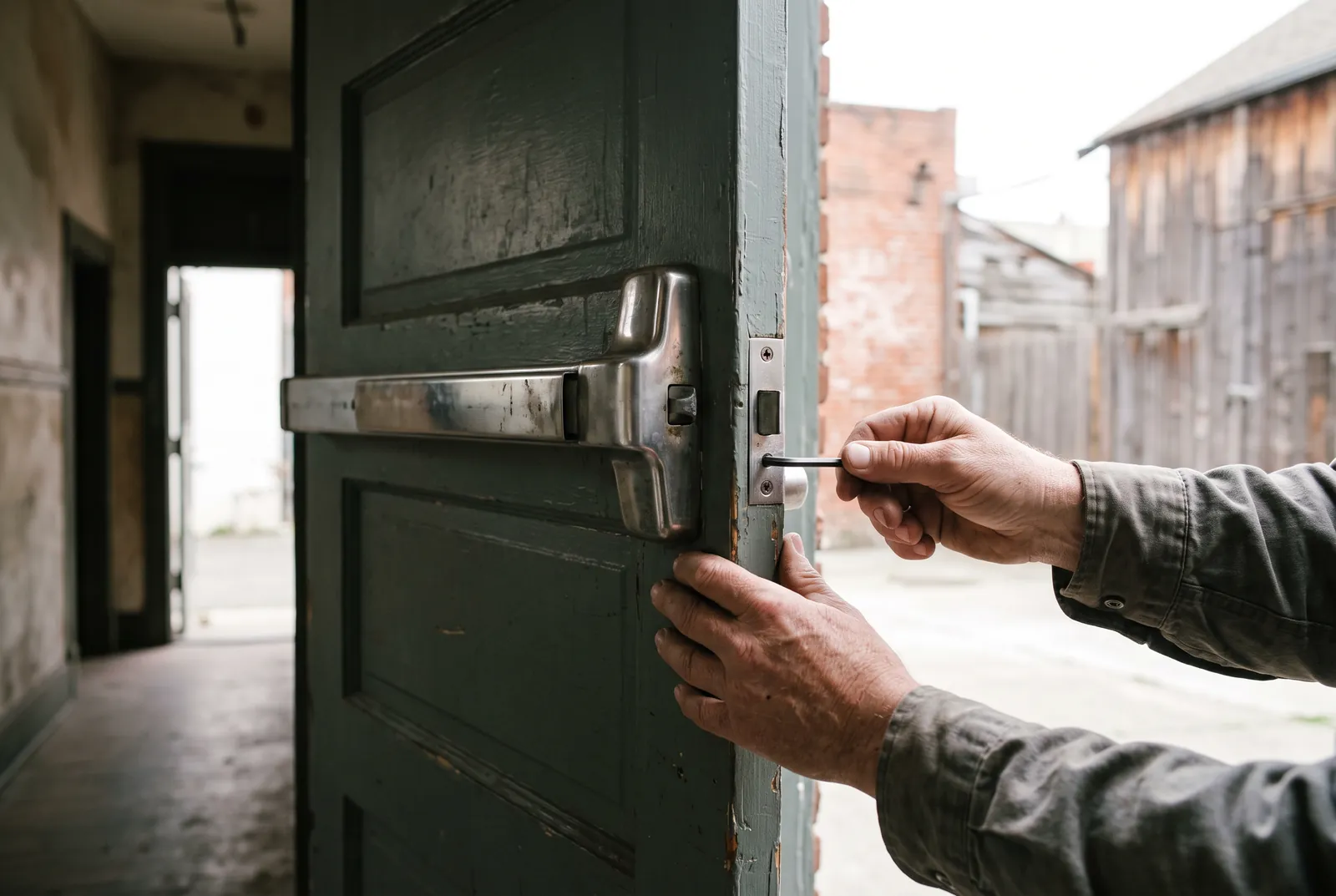
A push bar, an exit device, is the piece of hardware that ends the argument. It latches the door properly when it shuts, it opens with a shove from anywhere along its length even in the dark and even by somebody carrying something, and it takes a cylinder on the outside so staff can get back in with a key. Panic bars and exit devices are $289 to $739 per door, fitted, and the range is mostly about the door: a hollow metal leaf in a steel frame that still hangs true is the low end, and a door that has to be brought back into line before anything is bolted to it is the top.
Where a rear door is fire-rated, and in a building with tenancies above the shop it often is, there are two extra points. It has to latch by itself every time it closes, so a closer that has given up is a real fault rather than a nuisance. And it cannot be propped, which is the habit no hardware will ever fix. If the reason it gets propped is that staff cannot get back in with their hands full, that is a keypad or a card reader on the outside face, quoted after the door has been looked at, rather than a wedge.
The doors that belong to the building rather than to you
In the older blocks downtown the shop is one tenancy in a building with offices over it and a stair between them. That produces a set of doors that are nobody's shop: the street door to the stair, the shared rear hallway, the gate into the alley, a meter cupboard, sometimes a door onto a light well. Those belong to the owner of the building and the work on them is ordered by the owner or the manager, not by whichever tenant is standing next to them.
That is not a delaying tactic. A cylinder on a shared rear hall serves every tenancy that reaches the street through it, so one shop cannot decide on its own what the accountant upstairs will be carrying tomorrow. An email from a named person with authority for that door, saying which door and what is being done, is what puts the job on the schedule and what puts the invoice on the building rather than on whoever happened to pick up the phone.
It is also worth reading the lease in the same sitting. Most commercial leases downtown require the landlord to be given a key and many require notice before any lock is changed. Change the cylinder, hand a key over, put it in an email. The version of this that turns into an argument at the end of a tenancy is always the one nobody wrote down.
Offices above, and keys that stop growing
The offices around the courthouse have their own version of this. A firm takes a floor, and within two years there is a key for the suite door, another for the file room, another for the server closet, one for the rear stair and one that nobody can place. Then somebody leaves and the only honest option is to change everything.
A master key system fixes the shape of that: each door keeps its own key, one key sits above the lot and opens them all, and a departure means changing the doors that person could reach rather than the whole floor. It is the one line here with no published range on it. The chart has to be drawn from the doors that actually exist, so somebody walks the floor and counts them first, and the figure comes back in writing before a single cylinder is ordered.
The cheaper version, for a small suite, is simply keeping the count deliberate. Decide how many keys exist, write down who holds each, and keep one spare off the premises rather than in the drawer under the till. That costs nothing and it is what makes the eventual rekey a twenty-minute job instead of a survey.
The figures, and when to book it
Storefront door locks are $152 to $449 per door. Panic bars and exit devices are $289 to $739 per door. Rekeying an existing cylinder is $27 to $44 each, with the doors counted on the call so one number comes back for the premises. A business shut out of itself is a business lockout at $135 to $245. A door found forced at opening is $165 to $429, with the frame, the latch and the cylinder put back in the same visit and every part on its own line, because a claim needs lines rather than a total.
The $89 visit is already inside those figures. Evening between 8pm and midnight carries $45 and overnight between midnight and 7am carries $85, both counted in before you agree rather than appearing afterward. Arrival across Martinez averages 18 minutes and downtown is at the near end of that, which is the practical reason to do this work before opening rather than at two in the afternoon with a door out of service.
One last piece of timing. If the alarm has a contact tied to the door or the premises runs on a schedule, know who holds the alarm code before a cylinder changes. Being able to unlock a door you cannot disarm is its own kind of evening.
Quick answers
Can we put a padlock on the back door of the shop?+
Not during trading hours. A hasp and padlock, a slide bolt or a bar in brackets on a rear exit is the arrangement most likely to be written up, since leaving that way then needs a key or two separate movements. A push bar with a cylinder on the outside face secures the door and still opens with a shove, at $289 to $739 fitted.
Somebody put a key cylinder on the inside of our front door. Is that a problem?+
It is the other classic finding, and it is worth undoing. A door with people behind it has to release from within in one movement and without a key. If it went on because of a smashed pane, put the money into the glazing and into a deadlatch that cannot be shimmed, and give the inside face a plain turn.
Who orders work on the shared rear hall and the stair to the offices?+
Whoever owns or manages the building, by email, naming the door. That cylinder is carried by every tenancy in the block, so it is not one shop's call. Your own shop doors you instruct yourself, and both usually happen on one visit once the authorization is in hand.
Need it handled rather than read about?
(925) 436-1856