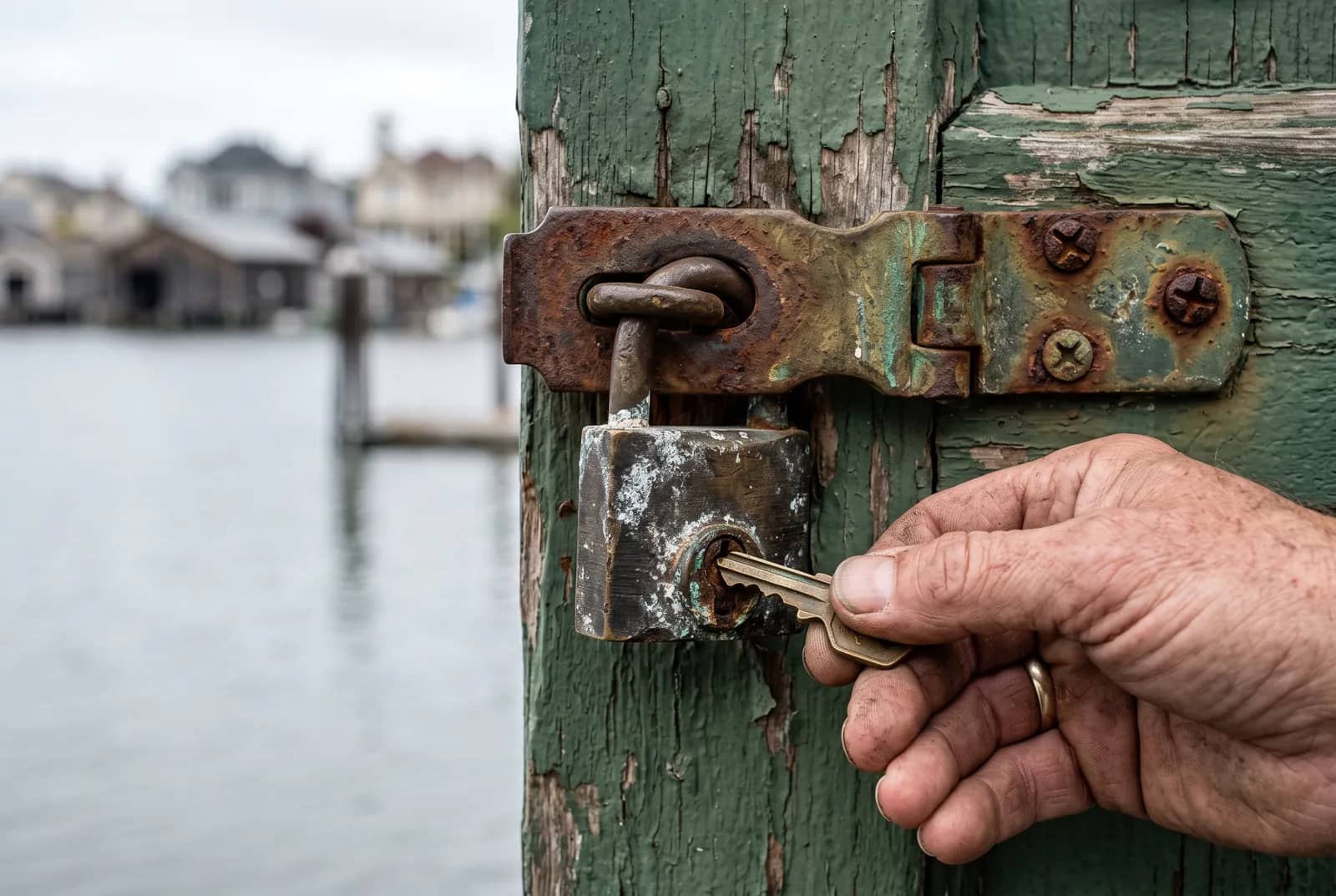
The only lock on the property with no shelter at all
Every other lock a household or a business owns has something over it. A front door has a porch or at least a header. A storefront cylinder sits in a frame under an awning. A padlock on a boat shed, a yard gate or a roll-up at the back of a warehouse hangs in the open on a hasp, taking wind, damp and sun on every side, all year, with nothing above it.
Down along the waterfront and out toward the marina that air comes off the strait. It is damp for a good part of the year and it carries salt, and salt does not need rain to work. It settles on metal, sits there, and gets going. A padlock that is never once rained on in a season can still be seized by spring.
Which is why the call from those blocks is so consistent. Nobody rings to say a padlock has been defeated. They ring to say the key will not turn, or that it turns and the shackle will not release, on a shed they need to be in this morning.
What actually fails, in order
The shackle spring, which is a thin piece of steel inside the body holding the shackle up when the lock is open. It is the finest metal in the lock, it is under load constantly, and it is the first thing damp reaches through the shackle holes. When it goes, the shackle no longer pops when the key turns and has to be pulled, then hammered, then given up on.
The plating on the body and the shackle. A bin padlock is usually plated steel, and the plating is a skin. One knock on a concrete step, one scrape on a hasp, and the skin is broken. Rust starts under the plating from that point and spreads sideways where you cannot see it, which is why these locks look tired long before they look broken.
The keyway, because of where it points. Most padlocks are hung with the keyhole facing up or out, so it collects damp, dust and whatever the wind is carrying. Then the pins and their springs pit, the key gets gritty, and somebody leans on a brass key against a stiff plug, which is how the key ends up in two pieces on a Saturday morning.
And the shackle itself at the heel, where it pivots. Grit in that hole plus corrosion turns a smooth pivot into something that grinds, and a shackle that grinds is one that eventually will not seat properly, so the lock does not lock even though the key turns.
What is worth putting there instead
Start with the body. Solid brass or stainless throughout beats plated steel by a wide margin in this air, because there is no skin to break. It costs more, and the arithmetic is straightforward: a plated lock replaced every couple of seasons against one that is still working in a decade.
Then the shackle. Stainless, and shrouded or closed where the use allows it, meaning a body that comes up around the shackle so there is very little of it exposed to get a tool onto. On a boat shed door or a yard gate a shrouded lock is usually a drop-in change. On a hasp with a small aperture it may not fit, and that is worth measuring before buying rather than after.
Then two details that cost nothing. Hang it so the keyway faces down, which keeps water and grit out of the only opening the lock has, and choose a body with a drain hole so whatever does get in has somewhere to go. And ask for a rekeyable cylinder rather than a sealed one. A sealed padlock is a lock you can never change your mind about, which is a strange thing to bolt onto a building you intend to keep.
The hasp decides more than the padlock does
This is the part that gets skipped everywhere. The best padlock made, hanging on a hasp fastened with four short screws into a soft redwood board that has been out in the weather since the shed was built, is holding almost nothing. Nobody has to touch the lock at all.
What a hasp wants is to be through-bolted rather than screwed, with a backing plate or at least large washers on the inside so the bolts cannot pull through the timber, and to be positioned so the fixings are covered when it is closed. A hasp whose own screws are exposed while it is locked is a hasp with its instructions written on it. On a metal door, bolts through with nuts on the inside and a plate behind them, for the same reason.
The other half is what the hasp is bolted to. A door edge that is soft, a frame that has rotted at the bottom where it meets the ground, a gate post that moves when you push it: those are the actual condition of the opening and no hardware fixes them. On the older sheds along the water it is common to find sound-looking timber that a screwdriver goes into. Where that is the case it gets said before anything is bolted to it.
Keeping them working, and keeping them on one key
Maintenance on these is small and it is not what most people do. Rinse a padlock that has been sitting in salt air, dry it, and give the keyway a dry film lubricant rather than anything oily, because oil stays wet and holds dust against the pins. Work the shackle a few times so the lubricant reaches the heel. Twice a year is enough.
The habit that kills more of them than anything else is leaving a padlock hanging open on the hasp all day, keyway up, while the shed is in use. That is when it fills. Where a lock is going to be off most of the day, hang it shut on the staple with nothing through it, or keep it inside.
On keys, the useful arrangement is a small number of them. A rekeyable padlock takes new pins like any other cylinder, at $27 to $44, so the shed can run on the same key as the yard gate and the back door instead of adding one more head to the ring. A sealed padlock has nothing inside it to repin, so it is matched and replaced rather than worked on. And where a site has several padlocks with different people needing different ones, that becomes a master key chart, which is drawn from the openings themselves after somebody has walked the yard and counted them.
Marina gates, shared sheds and the figures
One caution particular to these blocks. A gate onto a shared dock, a row of sheds under one roof, a gate serving several berths: none of that belongs to whoever happens to be standing at it. Every other person who uses that gate is carrying a key to it, and one of them cannot decide for the rest. Those jobs go through the harbor office or whoever holds the ground, in writing and with the gate named. Your own shed, your own yard gate and your own roll-up at the back of a unit you rent are yours to instruct.
Hardware here is priced as lock replacement and installation, $119 to $315, which covers a padlock and hasp arrangement fitted properly, including through-bolting and making the staple line up so the shackle is not being forced. Rekeying is $27 to $44 per cylinder. A business shut out of its own unit is a business lockout at $135 to $245, and a padlock that has seized on a working morning is generally opened without cutting where the mechanism gives any way in at all.
The $89 visit is counted into the figure before you agree to it. Evening arrivals between 8pm and midnight carry $45, overnight between midnight and 7am carries $85, and the average time to reach an address in this city is 18 minutes. Ninety days runs on the work itself, and the padlock carries whatever term its maker puts on it, which on a good brass body is usually the longer of the two.
Quick answers
Why does a new padlock seize within a year down by the water?+
Damp air off the strait carries salt, and it does not need rain to do its work. The shackle spring is the thinnest steel in the lock and goes first, then the plating breaks at a knock and rust spreads under it. A solid brass or stainless body with a drain hole, hung with the keyway pointing down, is the change that ends it.
Is a heavier padlock worth it on an old shed?+
Only alongside the hasp. Four short screws into weathered timber will let go long before any decent lock does. Through-bolts with a backing plate on the inside, and the fixings covered when the hasp is closed, matter more than the money spent on the padlock itself.
Can the shed and the yard gate be on the same key as the house?+
Where the padlocks are rekeyable, yes, at $27 to $44 per cylinder. A sealed padlock has nothing to repin and gets matched and replaced instead. A gate serving a shared dock or a shed row is not yours to change on your own, and that work is ordered by whoever holds the ground.
Need it handled rather than read about?
(925) 436-1856More guides